Kumulus Awarded in Museum of History and the Future Competition
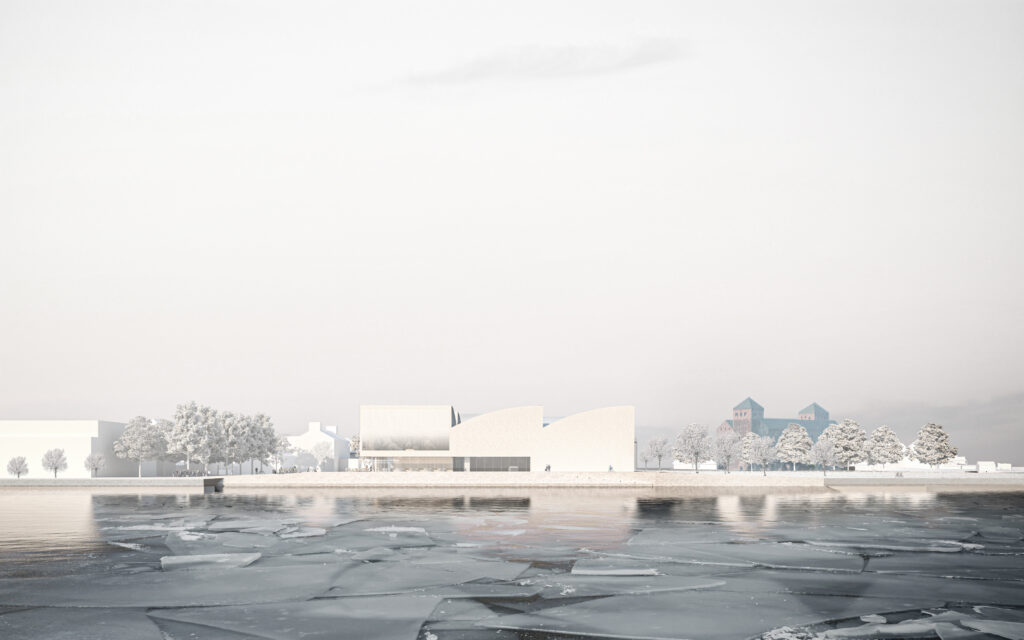
Kumulus, the entry developed by OOPEAA and Tmi Otto Heinonen is awarded honorary mention in the international open architecture competition for the Museum of History and the Future in Turku, Finland. The competition attracted a lot of interest and over 400 proposals of a very high caliber were submitted.
An International Architecture Competition for a Museum of History and the Future
An international architecture competition was organnized by the City of Turku in collaboration with the Finnish Association of Architects, SAFA to seek design proposals for the Museum of History and the Future in Turku. The site of the future museum is unique in terms of its cultural history and cityscape. The surrounding area is defined by the Turku Castle, River Aura, the Baltic Sea and the developing new Linnanniemi area. This combination offers a rewarding and at the same time demanding framework for the new building. It will become part of the national cultural landscape of the area.
The Museum of History and the Future will combine the latest technology with reflecting on the stories of history and the possibilities of the future. The museum is not only a place for learning and experiencing, but also a communal and inspirational space and a cultural landmark for the area. The principles guiding the planning and future activities of the museum are multi-channel, multi-voice, diversity, ecology, vitality, and impact.
- For more information on the competition, see HERE.
- The announcement of the results of the competition in Finnish can be found HERE.

Kumulus – A Museum that Weaves Together History and the Future
As a museum connected to community, history, nature, water, and Turku, the proposal ‘Kumulus’ provides a place for storytelling and learning, a place to gather, and a community living room. With its strong sculptural form and the façade with an artwork composed of light-colored glazed roof tiles made of local clay, Kumulus weaves together the history and the future of Turku as a city of culture, science, and innovation.
Combining the functions of a city museum and a science center, Kumulus introduces a strong new element into the network of museums and cultural organizations in the city. It will form the heart of the new art district in the harbor area. In its program, the museum boldly examines history allowing room for a multiplicity of perspectives on the future. This is reflected in the physical form of the building and the way in which it takes its place on the water’s edge. The new museum creates a mediating link between the open horizon of the sea and the historical Turku Castle.

A Landmark that Activates the Neighborhood
Kumulus forms a distinct landmark by the water’s edge. It greets the visitors approaching the city from the sea and frames a view with the historic Turku Castle in the background. It is visible from afar also when making one’s way from downtown towards the water. The new building enriches the historic shoreline and forms an inviting point of destination in the city. It houses a generous program of spaces dedicated to a varied range of activities. The new museum provides a community living room for the people of the neighborhood and a gathering place for all.
The Museum of History and the Future takes its place by the water as a symbol of the vibrant energy of the city. The building is positioned between a new public square on one side and the Linnanpuisto Park on the other. It is carefully placed in the point where the seafront meets the new neighborhood to be formed. There is a restaurant with terraces on the square and an open-air stage facing the park. They make it possible for the life in the building to extend out, enlivening the area around the museum. The new building offers views both towards the open horizon of the sea and towards the Castle.

Ecological, Adaptable and Durable
The building has a wood structure with the primary structure made of CLT. The cladding is made of locally sourced, glazed clay tiles. The flooring and other interior surfaces are made of durable materials that are easy to maintain and can handle a lot of wear. The materials used in the building are carefully selected to be low-carbon and healthy. The carbon footprint of wood construction is 40% lower than that of a regular concrete structure. The carbon handprint will be positive thanks to the use of local materials.
The structure is designed to be adaptable during use and possible to disassemble at the end of its lifecycle. The building has a stable structural frame that allows for reconfiguration of the interior spaces according to need. The connections are designed to be reversible connections and the building services are independent from structure. In that way, the end-of-life scenario of the building is integrated into its design.
- For a fuller presentation of the proposal ‘Kumulus’, see HERE.